Metal roofs are built to last, but leaks still show up more often than people expect.
In most cases, it’s not the metal that fails. It’s the way the roof was installed. Small metal roof installation mistakes can create weak points that don’t show up until the first heavy rain or strong wind.
Quick Answer
What causes metal roof leaks?
Metal roof leaks are usually caused by installation mistakes such as incorrect screw placement, poor sealing, flashing errors, and misaligned panels. These issues create openings where water can enter over time.
Why Metal Roofs Leak
(It’s Usually Installation, Not Material)
Most metal roof leaking problems start at the details, not the panels.
Metal itself is durable. The problem areas are:
- screws and fasteners
- panel seams
- flashing around openings
- roof transitions
A lot of homeowners ask, “Why is my metal roof leaking?”
The answer is usually simple. Something during installation created a path for water.
Most Common Metal Roof Installation Mistakes That Cause Leaks
These are the issues that come up again and again.
Incorrect Fastener Placement
Screws placed in the wrong spot or driven too tight or too loose can damage the sealing washer. Over time, this creates entry points for water.
Poor Sealing Around Screws
If washers fail or gaps form around fasteners, water can slowly work its way in, especially during heavy rain.
Improper Panel Overlap
Panels that are not aligned or overlapped correctly allow water to move under the seams instead of off the roof.
Weak or Missing Flashing
Areas around vents, chimneys, and skylights depend on proper roof flashing. Even small mistakes here can lead to leaks.
Wrong Roof Slope
Metal panels installed on the wrong slope can prevent proper drainage, leading to water buildup.
Mixing Different Metal Types
Using different metals together can lead to corrosion, which weakens the system over time.
Where Do Metal Roofs Usually Leak
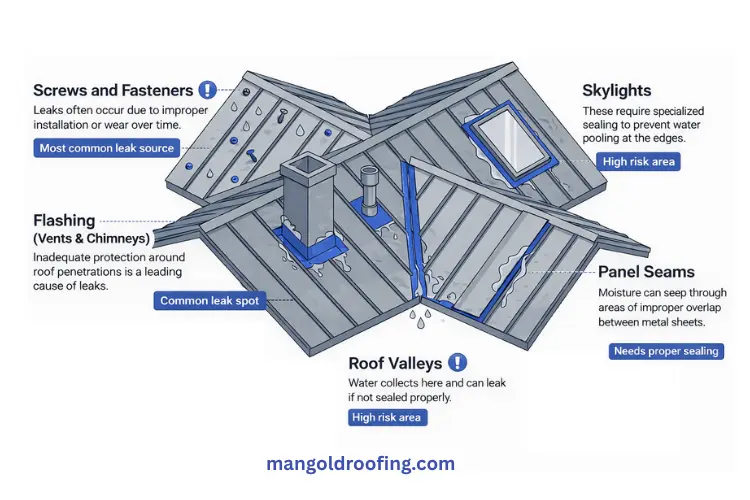
A quick visual can help you understand where metal roofs usually develop leaks.
Most leaks don’t start in the middle of panels; they start at these connection points.
Common leak points include:
- Around screws and fasteners
- Panel seams and overlaps
- Flashing areas
- Vents and skylights
Understanding the parts of a roof helps you see why these spots are more vulnerable.
Real-world observation: leaks almost always start at joints, edges, or penetrations.
Exposed Fastener vs Standing Seam — Leak Risk Difference
Not all metal roofing systems behave the same.
Exposed Fastener Roofs
- Screws are visible
- More penetration points
- Higher chance of leaks over time
Standing Seam Roofs
- Fasteners are hidden
- Fewer exposed points
- Better long-term leak resistance
The system you choose plays a big role in how likely leaks are to develop.
Metal Roof Screw Placement Mistakes
(Critical Detail)
This is one of the most common causes of metal roof leaks.
Issues include:
- Screws placed in the wrong part of the panel
- Overdriven screws that damage washers
- Underdriven screws that leave gaps
- Inconsistent spacing
Even small screw placement mistakes can lead to repeated leaks in the same area.
What Proper Metal Roof Installation Should Include
(What Prevents Leaks)
You don’t need to know every step, but understanding what proper installation includes helps you spot problems early.
- Correct fastener placement to prevent gaps and water entry
- Proper flashing installation around vents, chimneys, and roof edges
- Accurate panel alignment, so water flows off instead of under seams
- Allowance for expansion and contraction as metal reacts to temperature changes
Small details during metal roof installation make a big difference. These are the details professionals focus on to prevent leaks before they start.
Signs Your Metal Roof Leak Is Installation-Related
Some patterns clearly point to installation issues.
Look for:
- Leaks near screws or seams
- Water enters during heavy rain or wind
- Repeated leaks in the same spot
- Problems appearing soon after installation
These signs often indicate that the issue started during installation, not from wear over time.
When to Fix vs Reinstall a Metal Roof
Not every problem requires a full replacement.
Repair may be enough if:
- The issue is small and isolated
- Flashing or a few fasteners are the cause
Reinstallation may be needed if:
- There are multiple installation mistakes
- Leaks keep returning
- Seams or panels were installed incorrectly
In some cases, the decision depends on whether you are close to the point where you should replace your roof.
If you’re unsure whether the issue is isolated or part of a larger installation problem, having it checked by an experienced roofing contractor can help you avoid repeated repairs.
Conclusion
Most metal roof leaks are not caused by the material itself. They are the result of installation mistakes that create weak points over time.
Catching these early and understanding where problems usually start can help prevent bigger repairs later.
FAQs
Why does my metal roof leak after installation?
Most leaks after installation are caused by errors like improper screw placement, poor sealing, or flashing issues.
Where do metal roofs usually leak?
Leaks commonly occur around screws, seams, flashing areas, and roof penetrations like vents or skylights.
Do metal roofs leak at seams?
They can if panels are not overlapped or sealed correctly. Poor installation is usually the reason.
Can a metal roof leak even if it’s new?
Yes. If installation mistakes were made, leaks can appear early, sometimes after the first heavy rain.
How do I know if my roof leak is from the installation?
Leaks in the same area, near fasteners, or shortly after installation often point to installation-related problems.
Can metal roof leaks be fixed without replacing the whole roof?
Yes, if the issue is isolated. But if multiple mistakes exist, partial or full reinstallation may be needed.