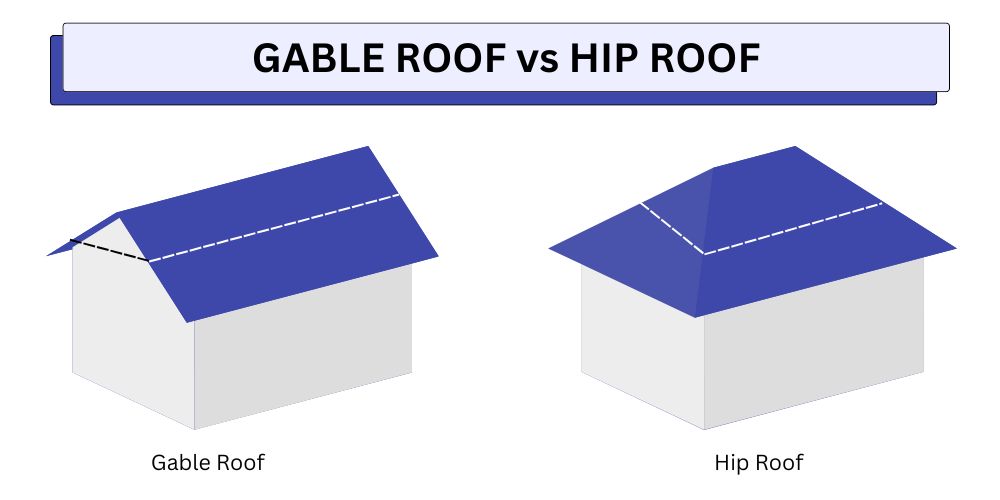
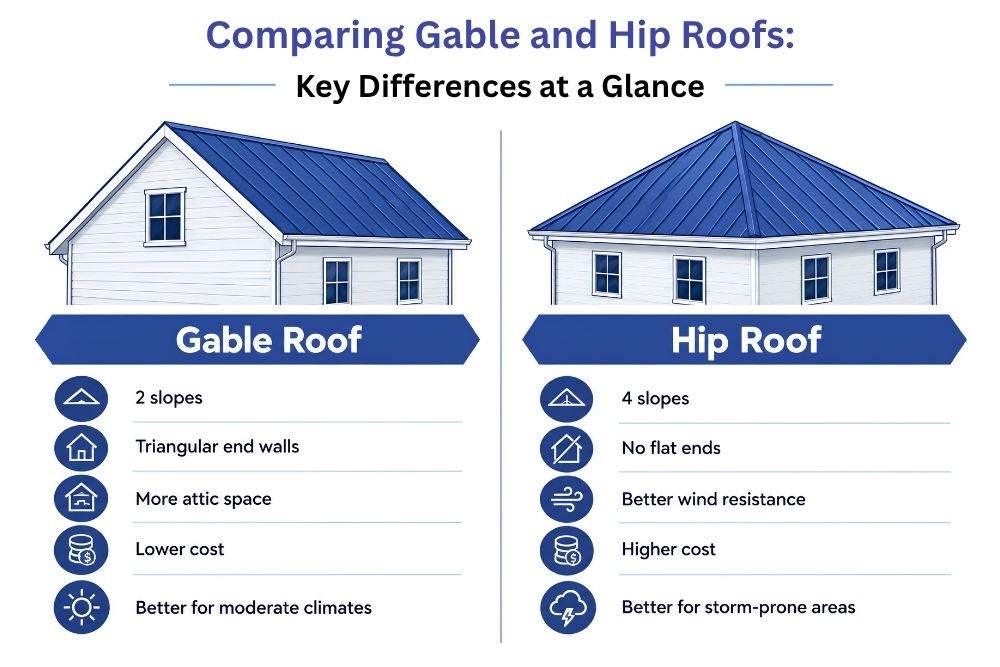
Gable roofs are the most common roof shape in the US for a reason. Two slopes, one ridge, a triangle at each end.
A hip roof is different. All four sides slope down to the walls. No flat triangular ends, no vertical faces. From any angle, it looks the same.
Both work well for most homes. Your climate, budget, and attic needs will point you toward the right one.
Gable Roof
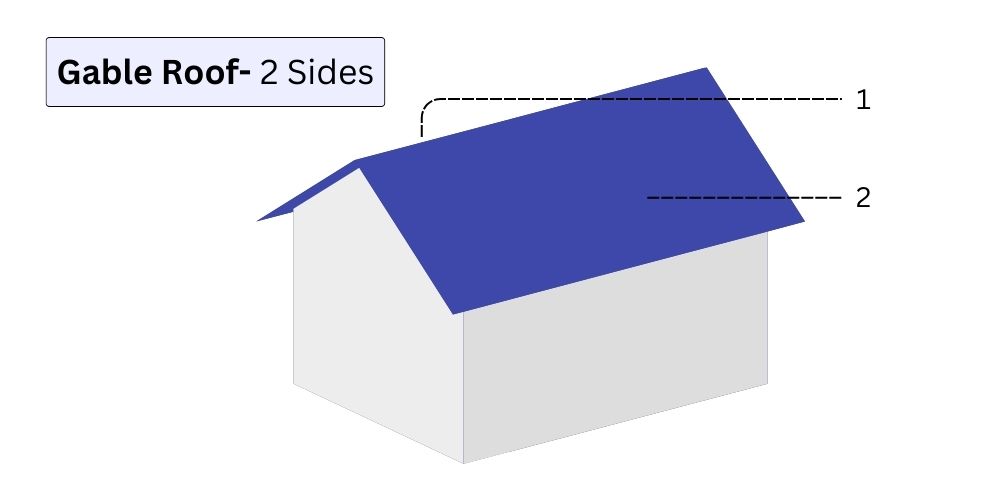
Gable roofs shed water well, leave you with usable attic space, and cost less to frame than most other roof styles. They shed water well, leave you with usable attic space, and cost less to frame than most other roof styles.
Wet climates suit them well. If you are in an area that gets serious wind, the gable ends are the part that needs attention. Good bracing there makes a bigger difference than most homeowners realize.
Most common roofing materials work well on a gable roof:
- Shingle Roofing — the most widely used option, practical and cost-effective
- Metal Roofing — holds up well in storm-prone areas and lasts longer than most materials
- Clay or Concrete Tiles — heavier and more durable, good insulation in hot climates
- Wood Shingles or Shakes — traditional look, needs more upkeep in humid conditions
Types of Gable Roof
Gable roofs come in several configurations. The most common gable roof styles used in San Antonio homes include front gable, side gable, cross gable, Dutch gable, and box gable.
1. Front Gable Roof
A front gable roof has a gable end directed towards the front of the house, making it a prominent design feature. These roofs are commonly used in colonial and Georgian-style homes and add character and curb appeal.
2. Side Gable Roof
The side gable is the most traditional type, in which two equal slopes meet at a middle ridge. This type is extremely popular for suburban homes as it is easy to construct.
3. Cross Gable Roof
A cross-gable roof contains two or more gable sections that intersect at different angles. This roof type is often used in homes with complex plans, creating visual interest and defining separate wings or portions of the house.
4. Dutch Gable Roof
A Dutch gable roof is a combination style that combines a hip roof with a small gable at the top. This style enhances attic space and provides a fashionable appearance while maintaining some wind resistance.
5. Box Gable Roof
A box gable roof incorporates longer triangular sections at the gable ends, giving the building a more framed, enclosed look. This design contributes to the house’s beauty without compromising the traditional benefits of a gable roof.
Pros of Gable Roof
1. Less Expensive
On cost, the math is simple. Two roof planes use less material than four and take less time to frame. That gap between gable and hip roof pricing is not marginal. It is one of the more meaningful cost differences in residential roofing.
2. Ventilation
Venting your attic is the key to keeping your roof and house in great shape. The proper vents will allow any excess moisture to escape. You can put gable vents in a gable roof, which can help you reduce humidity and keep your home healthy.
3. More Attic Room
Gable roofs also give you more space for your attic. The peaked shape of a gable roof creates more usable attic space, which can be used for storage, a finished room, or simply better insulation coverage.
4. Decoration
Gable roofs provide more room for decoration. Gable brackets, pediments, and other ornaments can enhance a roof’s appearance. Gable decoration is available in different materials and styles, ranging from simple and modern to intricate and traditional.
Cons of Gable Roof
1. Poorer Wind Performance
The flat triangular end of a gable roof gives wind something to push against. In a strong storm that pressure can work its way up and under the roof structure. It is not a flaw in the design so much as a physics problem. Proper gable-end bracing and solid wall-to-roof connections address it directly.
2. Harder to Construct
Gable roofs are not particularly hard to build, but in windy areas they need more thought than a standard installation. The gable ends take the most wind pressure, so bracing and wall-to-roof connections matter. Ask your contractor about this upfront, not after the crew has packed up.
Hip Roof
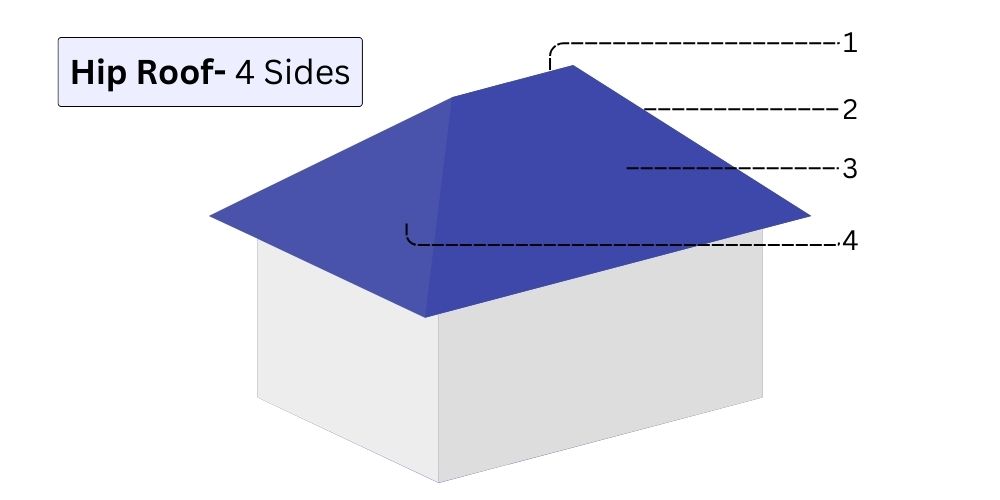
A hip roof is a roof in which all four sides of the roof slope downward from the peak. It has no gable or flat end. Hip roofs are common on church steeples, where they often feature a high pitch. They’re common in suburban homes, too, because they’re simple to construct. The walls under the roof are all the same height, which is convenient to build.
Because hip roofs have slopes on all sides, they require durable and adaptable materials:
- Metal Roofing – Provides excellent longevity, wind resistance, and durability, making it a great choice for hip roofs.
- Architectural Shingles – A premium asphalt shingle option that enhances wind resistance and aesthetic appeal.
- Slate Tiles – A long-lasting, elegant option that requires a strong supporting structure.
- Clay or Concrete Tiles – Offers exceptional weather resistance and insulation, especially in hot climates.
Types of Hip Roof
1. Simple Hip Roof
A simple hip roof consists of four equally sloping sides that meet at a central ridge. It is the most common and straightforward version, often used in traditional homes.
2. Pyramid Hip Roof
In a pyramid hip roof, all four sides slope inward to form a single peak at the top. This style is often seen in smaller structures, such as bungalows and gazebos, and offers excellent wind resistance.
3. Cross Hip Roof
A cross hip roof is created by combining two hip roof sections at right angles, forming a more complex roofline. This design is often used in larger homes with multiple wings, enhancing both structural strength and visual appeal.
Pros of Hip Roof
1. Superior Wind Resistance
Hip roofs are ideal for high winds and outperform gable roofs. Wind tunnel tests show that roofs with four hips and a square footprint handle extreme winds better. They require less diagonal bracing and lack a flat face for the wind to catch, making them a better choice for homes in windy conditions.
2. Increased Durability and Longevity
Because of its balanced design and lack of vertical gable ends, a hip roof is less likely to suffer from structural failure. The sloped surfaces distribute weight more evenly, reducing stress on the walls and foundation.
3. Enhanced Drainage and Weather Protection
Like gable roofs, hip roofs allow rainwater and snow to slide off easily, minimizing the risk of water pooling and leaks. Their structure also provides better protection against wind-driven rain and debris.
4. Added Structural Strength
The interlocking nature of a hip roof’s slopes makes it inherently stronger than a gable roof. Additional bracing and reinforcements can further enhance this strength, making it a long-lasting roofing solution.
5. Aesthetic Appeal and Versatility
Hip roofs have a clean, symmetrical look that complements various architectural styles. They can be adapted to modern, classic, and contemporary designs, making them a visually appealing choice for homeowners.
Cons of Hip Roof
1. Snow Performance
As they usually have a lower pitch than gable roofs, hip roofs may not be as good at shedding snow. All roofs need to be built to code, but it may be more challenging to design a hip roof that fits your building code’s snow load standards.
This cold weather performance may explain why gable roofs are more popular than hip roofs in snowy areas. That being said, architects can design hip roofs that have proper winter performance. Plus, you should protect your hip roof with ice and water protectors to limit the effect of snowy weather.
2. Attic Space
Hip roofs also have less attic space than gable roofs because they require diagonal bracing that takes up space. In contrast, a gable provides a vaulted ceiling and additional space. However, you can include dormers on hip roofs to offer extra space and natural light to make up for the lack of a gable.
3. Expense
You may also wonder if a hip roof is more expensive than a gable roof. In fact, hip roofs are more costly. Not only is a hip roof challenging to design, but it also requires more roofing materials than a gable roof. So, you can expect a slightly increased cost if you choose a hip roof.
In Texas and other storm-prone states, roof shape can affect your insurance premium. A hip roof sometimes qualifies for a wind mitigation discount. Worth a quick call to your provider to find out. In some cases, the long-term insurance savings can offset part of the higher upfront cost.
Gable Roof or Hip Roof: Which Is Right for You?
Choose a gable roof if:
- Budget is the priority
- You want more attic space
- You live in a moderate climate with heavy rain or snow
- Wind exposure is not a major concern in your area
A hip roof makes more sense when:
- Wind is a real concern where you live, not just a possibility
- You plan to stay in the house long enough that durability pays off
- You want a roof that looks the same from every side of the house
In San Antonio and South Texas, summer storms regularly bring strong winds. A hip roof handles wind better because all four sides slope away from wind pressure rather than presenting a flat vertical face. If you are building new or replacing a full roof in this area, it is worth at least getting a hip roof in the conversation.
Key Differences: Gable Roof vs Hip Roof
| Feature | Gable Roof | Hip Roof |
| Design | Two sloping sides meet at a ridge, forming a triangular shape at the ends | Four sloping sides meeting at a peak, with no flat ends |
| Cost | Less expensive due to fewer materials needed | More expensive due to additional materials and complexity |
| Wind Resistance | Weaker in high winds; wind can lift the truss if there’s an overhang | Excellent wind resistance due to sloped sides and balanced design |
| Snow and Rain Performance | Excellent at shedding rain and snow due to steep slopes | Good drainage, but lower pitch may not shed snow as efficiently |
| Attic Space | More attic space; can be used for storage or additional rooms | Less attic space due to diagonal bracing, but dormers can be added |
| Construction Complexity | Easier to construct but may require extra bracing in windy areas | More complex to construct due to the four sloping sides |
| Aesthetic Appeal | Traditional look, more room for decorative elements like gable brackets | Symmetrical and versatile, it suits various architectural styles |
| Structural Strength | May need additional reinforcement for stability in storms | Stronger due to interlocking slopes, reducing stress on walls |
| Common Uses | Residential homes, colonial and modern designs | Suburban homes, church steeples, high-wind areas |
| Best for | Areas with heavy rain or snow, budget-friendly projects | Wind-prone areas, long-lasting and durable roofing needs |
Trust Mangold Roofing for Expert Roofing Solutions
Neither roof is the wrong choice. A gable roof costs less and gives you more attic room. A hip roof handles wind better and tends to need less attention over time in storm-prone areas.
San Antonio gets real summer storms. Some homeowners here go with hip roofs for the wind performance. Others stick with gable roofs and make sure the bracing is done right. Both approaches work when the installation is solid.
Mangold Roofing has been doing this in San Antonio for over 50 years. If you are weighing one against the other for your home, we can walk you through what makes sense for your specific situation.