A metal roof can have solid panels and still develop problems around the screws holding them in place. One screw driven too far, a damaged washer, or a fastener that misses the roof’s supporting structure can create trouble.
Think of a roofing screw as a small seal around a hole in the roof. It needs to hold the panel securely while keeping water out. If either job fails, the surrounding area can become a weak point.
The right screw depends on the panel profile, the material beneath it, and the manufacturer’s installation instructions. This guide covers screw types, placement, spacing, correct installation, and what to do when fasteners start causing problems.
Note: This guide focuses mainly on exposed fastener metal roofs, where screws are visible across the panels. Standing seam and other concealed fastener systems attach differently. Do not add exposed screws through those panels as a repair unless the roof manufacturer specifically recommends that method.
What Are Metal Roofing Screws?
Metal roofing screws attach roofing panels and related components to the structure beneath them. Many screws used on exposed-fastener metal roofs also have a sealing washer beneath the head to help keep water out around each penetration.
How Do Metal Roofing Screws Work?
The screw’s threads grip the supporting material, helping hold the panel in place. Its length, thread design, and drill point must suit the materials being joined.
On exposed-fastener roofs, a bonded sealing washer compresses against the panel when the screw is installed correctly. That compression helps seal the opening around the fastener.
Roofing Screws vs. Metal Roof Fasteners
The terms overlap, but they don’t mean exactly the same thing. Roofing screws are one type of metal roof fastener. The broader category can also include clips and other attachment components.
Exposed-fastener panels typically have visible screws through the panel surface. Concealed-fastener systems, including many standing seam roofs, use clips or other designed attachments to hide the primary fasteners.
Types of Metal Roofing Screws
Not every roofing screw works with every panel or supporting structure. The main differences involve thread design, drilling capability, and the materials the screw is designed to join.
| Screw type | Typical application | What to check |
| Metal-to-wood | Attaching panels to suitable wood supports | Thread design, length, and required penetration |
| Metal-to-metal | Attaching panels to steel framing or purlins | Drill-point capacity, thread compatibility, and steel thickness |
| Self-drilling | Joining materials within the screw’s rated drilling capacity | Drill-point specifications and installation requirements |
| Self-tapping | Forming threads in the receiving material | Whether a pilot hole is required |
| Screws with bonded sealing washers | Exposed-fastener roofing systems | Washer compatibility, condition, and compression |
Metal-to-Wood Roofing Screws
These screws are designed to grip suitable wood supports. They must be long enough to reach the support and provide the required thread engagement.
A screw that is too short may not hold securely. One with the wrong thread design may also fail to grip the wood as intended.
Metal-to-Metal Roofing Screws
These fasteners connect roofing panels to metal framing or purlins. Their drill points and threads must match the thickness and type of metal being penetrated.
A screw designed for thin sheet metal may not work with thicker structural steel. Check the product specifications instead of assuming that one self-drilling screw can handle every metal support.
Self-Tapping vs. Self-Drilling Roofing Screws
A self-tapping screw forms threads in the material as it is driven, but it may need a pilot hole first. A self-drilling screw has a drill-shaped tip that makes the hole before forming the threads. All self-drilling screws are self-tapping, but not all self-tapping screws are self-drilling.
The terms are sometimes used loosely in product descriptions, so check the screw’s design, material compatibility, and installation instructions before choosing one.
Screws With Bonded Sealing Washers
A bonded washer combines a sealing material with a metal backing beneath the screw head. When compressed correctly, it helps keep water from entering around the screw.
A cracked, displaced, deteriorated, or crushed washer may no longer seal properly. Simply choosing a screw with a washer isn’t enough; the washer must also be compatible with the roofing system and installed correctly.
How to Choose the Right Metal Roofing Screws
The right screw must match the panel, the supporting structure, and the conditions the roof will face.
Check these details before choosing a fastener:
- Panel profile: The panel design determines the approved fastening method.
- Supporting material: Wood and metal supports require compatible thread designs and engagement.
- Screw dimensions: Diameter and length must meet the system’s requirements.
- Drill-point capacity: The screw must be rated for the material it needs to penetrate.
- Sealing washer: Its size and material must suit the application.
- Corrosion resistance: The fastener’s finish must suit the exposure conditions and remain compatible with surrounding materials.
- Design loads: The fastening schedule must meet the project’s requirements.
The metal roof panel profile is a useful starting point because different panels can require different fastening details.
What Size Screws Should I Use for Metal Roofing?
There isn’t one screw size that works for every metal roof. The correct diameter and length depend on the panel system, supporting material, assembly thickness, and required engagement with the structure.
Don’t choose a replacement screw simply because it fits through the existing hole. It must also suit the original application and the condition of the surrounding material.
How Long Should Metal Roofing Screws Be?
The screw must pass through the materials being fastened and engage the support as required by the roofing system. Insulation, spacers, or other components between the panel and support can affect the required length.
Use the panel manufacturer’s fastening details and the screw manufacturer’s specifications to confirm the size.
Where Should Metal Roofing Screws Be Placed?
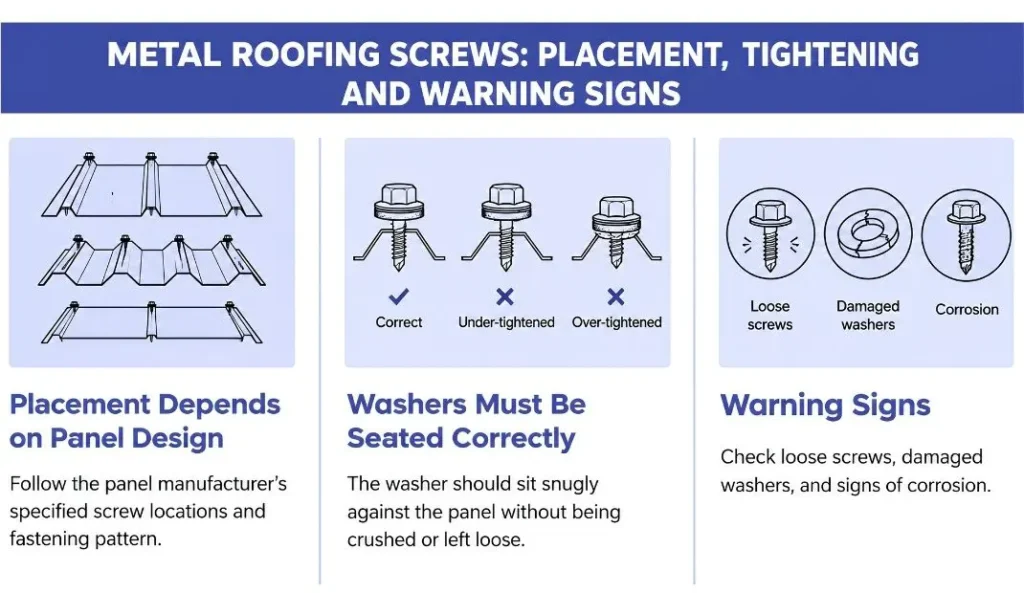
Screw placement depends on the panel profile and its installation instructions. Some exposed-fastener systems require screws through the flat or pan of the panel, while others specify different locations.
A screw pattern that works for one panel may be wrong for another.
Where Should Screws Be Installed on a 5-Rib Metal Roof?
On many 5-rib exposed-fastener panels, field screws are installed through the flat, or pan, of the panel and into the supporting purlin, not through the high rib. However, “5-rib” is not a universal fastening specification. Before adding or replacing screws, follow the installation instructions for the exact panel system on the roof.
For example, Union Corrugating’s MasterRib installation guide specifies screws in the flat of the panel at every purlin. Other panel systems may use different fastening details, so always check the manufacturer’s instructions.
The same care applies to corrugated panels and roof ridge details. Raised ribs, lower channels, and roof peak trim can have different fastening requirements, so don’t assume that a screw belongs in the ridge or valley based on the panel shape alone. Check the manufacturer’s instructions for the correct location and make sure each fastener engages the intended roof support.
Metal Roof Screw Spacing and Patterns
Screw spacing describes how fasteners are distributed across the panels and along their edges. The required pattern depends on the panel design, support layout, design loads, roof location, and manufacturer’s fastening schedule.
| Factor | Why it matters | Where to check |
| Panel profile | Determines approved fastening locations | Panel installation instructions |
| Support spacing | Affects where screws can engage the structure | Roof framing plans and system details |
| Design loads | Influences the required attachment strength | Project specifications and engineered fastening schedule |
| Roof edges and perimeter | May require different fastening details from the panel field | Manufacturer instructions and project requirements |
| Panel laps and accessories | Need compatible attachment and sealing details | Panel and accessory installation guides |
How Many Screws Are Needed, and How Far Apart Should They Be?
The number of screws and the distance between them depend on the panel system, roof layout, supporting structure, design loads, and required fastening pattern. Some areas, such as roof edges, panel laps, and accessory connections, may have different requirements from the main panel field.
There is no single screw spacing or quantity that applies to every metal roof. Use the manufacturer’s installation schedule for the exact panel and account for the roof’s dimensions and additional fastening details when calculating the total number of screws. Don’t copy a pattern from another roof unless it is approved for the same system and conditions.
How to Install Metal Roofing Screws Correctly
Correct installation helps the fastener hold the panel securely while allowing its sealing washer to work as intended. The panel manufacturer’s installation manual and the fastener manufacturer’s instructions should determine screw placement, tooling, and tightening requirements.
Do You Need to Pre-Drill Metal Roofing Screws?
Not always. A self-drilling screw can create its own hole when the material is within its rated drilling capacity. Other screws and applications may require a pilot hole.
Check the screw’s specifications and the thickness of the material being penetrated. A screw designed for thin metal shouldn’t automatically be used with thicker structural steel.
How Tight Should Metal Roofing Screws Be?
The washer should sit firmly against the panel and compress enough to create the intended seal without being crushed or distorted.
An underdriven screw may leave the washer too loose. An overdriven screw can damage the washer, deform the panel, or compromise the connection. A screw installed at an angle may also compress the washer unevenly.
Use the tightening guidance specified by the fastener manufacturer. A universal torque value or drill setting may not apply to your screw and panel combination.
Use the Right Tools and Keep the Panels Clean
Use a variable speed screw gun with suitable depth or clutch control when installing metal roofing screws. An impact driver can apply too much force, potentially damaging the sealing washer, stripping threads, breaking fasteners, or chipping the panel’s painted finish.
As you work, remove metal shavings from the roof instead of leaving them on the panels. These small metal particles can rust and stain the finish if they remain on the surface. Always follow the roofing panel and fastener manufacturer’s instructions for the recommended tool and tightening method.
Common Metal Roofing Screw Installation Mistakes
Common mistakes include:
- Using a screw that doesn’t suit the panel or supporting material.
- Installing fasteners in the wrong locations.
- Missing the supporting structure.
- Driving screws too loosely or too tightly.
- Damaging the sealing washer.
- Ignoring the required fastening schedule.
These mistakes can weaken the connection or compromise the seal and are among the most common metal roof installation mistakes on exposed-fastener systems. Correcting the installation problem is more useful than simply covering the affected screw with sealant.
Why Are Metal Roof Screws Backing Out or Leaking?
| Symptom | Possible Cause | Next Step |
| Screw has backed out | Missed support, damaged threads, enlarged hole | Inspect hole and substrate before replacing |
| Leaking around screw | Damaged or crushed washer, loose fastener | Check washer condition and screw tightness |
| Rust around screw head | Incompatible fastener, coating failure | Assess corrosion depth before replacing |
| Screw spins but does not tighten | Enlarged or stripped hole | Hole repair or panel replacement may be needed |
| Washer displaced or cracked | Overdriving, age, UV deterioration | Replace fastener with compatible product |
A loose or leaking screw may point to an installation problem, damaged support material, a deteriorated washer, corrosion, or a compromised hole. The screw itself isn’t always the only problem.
Why Do Metal Roof Screws Become Loose?
A screw may loosen if it was installed incorrectly, doesn’t engage the intended support, or no longer holds securely in the material beneath it. Damaged threads, an enlarged hole, or deterioration around the fastener can also affect its holding power.
Movement may contribute in some installations, but it shouldn’t automatically be blamed for every loose screw. The fastener and surrounding material need to be checked.
Do Metal Roofs Leak Around Screws?
Yes. Water can enter around a fastener if the washer is damaged, the screw is loose, the penetration is compromised, or the wrong fastener was used.
But water near a screw doesn’t prove the screw caused the leak. Flashing, panel laps, and nearby roof details can also allow water to enter.
How Can You Seal a Leaking Metal Roof Screw?
Start by identifying why the screw is leaking. Inspect the fastener, washer, panel, and surrounding material before choosing a repair.
A damaged fastener may need replacement with a compatible product. An enlarged hole or damaged panel may require a different repair altogether.
Applying sealant over the screw isn’t a reliable permanent fix for every problem. The product must suit the roofing system, and the repair must address the actual source of the water. If the water is coming from flashing or a panel lap instead, sealing the screw won’t solve it.
A leak’s location can be misleading, so metal roof leaks need to be traced to their actual entry point before repairs begin.
When Should Metal Roof Screws Be Replaced?
Replace or repair fasteners when they no longer hold securely or seal properly. There isn’t a single replacement interval that applies to every metal roof.
How Often Should Metal Roof Screws Be Replaced?
The need for replacement depends on the condition of the screws, washer deterioration, corrosion, loosening, and the roof manufacturer’s maintenance recommendations.
Age alone doesn’t mean every screw needs replacing. Check the fasteners and the surrounding panels to determine whether they still perform as intended.
What Are the Signs That Metal Roof Screws Need Replacing?
Look for:
- Visible corrosion on the screw or around the penetration.
- Cracked, deteriorated, or displaced sealing washers.
- Screws that have backed out or become loose.
- Missing fasteners.
- Water stains or signs of moisture near fastener locations.
These signs warrant investigation. The right repair depends on the condition of the panel and the supporting structure, not just the appearance of the screw.
What Are the Best Replacement Screws for a Metal Roof?
Choose a replacement that suits the existing panel system, supporting material, and exposure conditions. Matching the original screw’s appearance or dimensions isn’t enough.
If the original screw failed because the hole is damaged or it missed the support, installing another similar screw may leave the underlying problem unresolved.
What Affects the Cost of Metal Roof Screw Repair?
The cost depends on how many fasteners need attention, roof size and access, panel condition, and whether the work reveals additional damage.
Replacing a few accessible screws is different from correcting a widespread fastening problem across a large roof. The scope needs to be established before repair costs can be estimated reliably.
Exposed-Fastener vs. Concealed-Fastener Metal Roofing
Exposed-fastener roofing has screws that remain visible on the panel surface. Concealed-fastener systems use clips or other attachment details to hide the primary fasteners.
The difference affects how each system is installed and maintained. Exposed-fastener roofs need attention to screw and washer condition, while concealed systems rely on their clips, seams, and other designed attachment details.
These fastening differences are one consideration when comparing standing seam and corrugated metal roofing. Panel design, intended application, installation quality, and maintenance also affect how each system performs.
Conclusion
Metal roofing screws may be small, but they help hold the panels in place and protect the openings where fasteners pass through the roof.
Choose screws that match the panel and supporting structure, follow the specified placement and spacing, and make sure the washers aren’t loose or crushed. If screws back out, corrode, or leak, find out why before attempting a repair.
A loose screw may be a simple fix. A damaged hole, failed support, or leak coming from a nearby roof detail may require more work. Identifying the cause first helps prevent the same problem from returning.
Mangold Roofing & Sheet Metal Inc. has served San Antonio homes and businesses since 1974. If exposed fasteners are backing out, leaking, or showing corrosion, our team can inspect the roof, identify the source of the issue, and recommend the appropriate repair. Call (210) 494-7615 to request an estimate.
FAQs About Metal Roofing Screws
What is the best screw to use in metal roofing?
Use a screw approved for the specific panel, supporting structure, and installation conditions. Check its dimensions, thread design, drilling capacity, washer, and corrosion compatibility.
Do you need to pre-drill metal roofing screws?
Not always. Suitable self-drilling screws can penetrate materials within their rated capacity without a pilot hole. Other fasteners or applications may require pre-drilling.
How do you keep screws from backing out of a metal roof?
Use the correct fastener, follow the specified placement, and ensure the screw engages the intended support. If screws keep backing out, investigate the cause instead of repeatedly tightening them.
Do metal roofs leak at the screws?
They can. Damaged washers, loose fasteners, improper installation, and compromised penetrations can allow water to enter. Nearby flashing or panel details may also be responsible.
How often should metal roof screws be replaced?
There is no universal replacement schedule. Inspect fasteners for corrosion, washer deterioration, loosening, and other signs of failure, and follow the roofing manufacturer’s maintenance recommendations.
Are exposed-fastener metal roofs a good choice?
They can suit many applications when the panel system is appropriate and installed correctly. Their visible screws and sealing washers need attention during maintenance, so consider those requirements alongside the roof’s cost and intended use.