You notice water droplets underneath your metal roof even though it hasn’t rained. Or you see the underside of the panels “sweating” on a humid morning and wonder where the water came from.
Before assuming the roof is leaking, consider condensation.
Metal roof condensation happens when moisture in the air reaches a surface that is cold enough for that moisture to turn into water droplets. Metal roofing can make this more noticeable because the panels can respond quickly to changes in temperature, but the metal itself is not creating the moisture. The amount of moisture in the air, the roof assembly, insulation, ventilation, and temperature differences all play a role.
The first question is usually simple: Is this condensation, or is water getting in from outside?
Is It Condensation or a Metal Roof Leak?
This is often the hardest part for a homeowner to figure out. You see water and naturally assume rain found a way through the roof. Sometimes that is exactly what happened. Other times, the water formed on the underside of the metal without any rain reaching the roof at all.
When you find water under a metal roof, a few clues can help you work out whether condensation or a leak is more likely. Look at when the moisture appears, where it collects, and whether weather or temperature changes seem to trigger it.
| What You Notice | More Likely Condensation | More Likely a Leak |
| Happens even when it hasn’t rained | Yes | No |
| Droplets spread across the underside | Yes | No |
| Appears with humidity or temperature changes | Yes | No |
| Appears after rain | No | Yes |
| Moisture is concentrated in one area | No | Yes |
| Water appears near flashing or a penetration | No | Yes |
| Water follows a specific path | No | Yes |
| Recur during similar weather conditions | Yes | No |
These signs can point you in the right direction, but they do not confirm the source on their own. A roof can also have a leak and a condensation problem at the same time, so recurring moisture should be investigated rather than assumed to be one or the other.
Why Is My Metal Roof Sweating?
Think about a cold glass on a humid day. The water on the outside of the glass didn’t come through the glass. Moisture already present in the surrounding air condensed when it touched the cold surface.
Metal roof sweating works on the same basic principle.
Moist air → cold roof surface → condensation → water droplets
The temperature at which moisture begins turning into liquid is called the dew point. When a roof surface reaches that point while surrounded by moisture-laden air, droplets can form.
The metal roof itself is not creating the water. The moisture is already in the air.
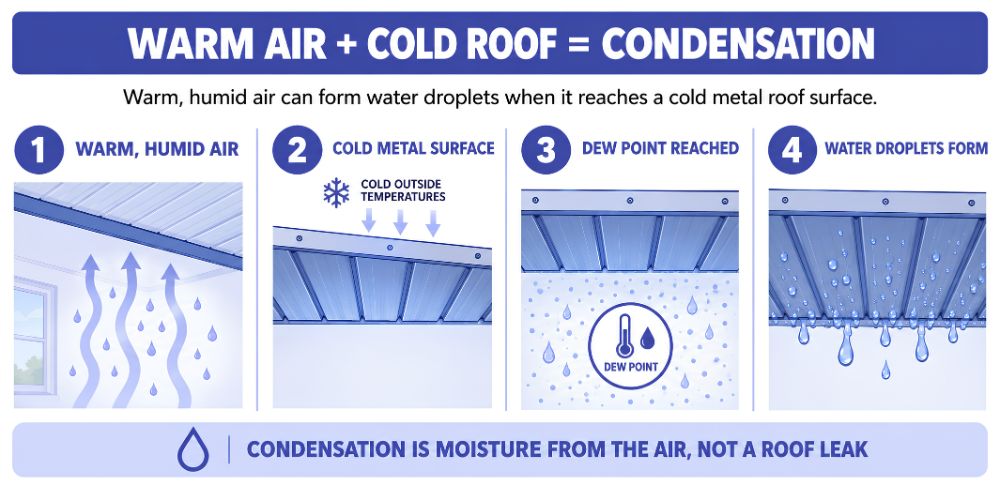
Why Metal Roofing Makes Condensation Easy to Notice
Metal panels can change temperature quickly. A roof that cools significantly overnight can create a cold surface for warm, humid air to contact.
That is one reason condensation can be especially noticeable:
- Early in the morning
- During humid weather
- After rapid temperature changes
- When warm indoor air reaches cold roof components
it does not mean every metal roof will sweat. The building, climate, insulation, air movement, and roof assembly all matter.
What Causes Condensation Under a Metal Roof?
There usually is not one single cause. Condensation develops when enough moisture reaches a surface that is cold enough for the moisture to condense.
High Indoor Humidity
Everyday activities add moisture to the air inside a building.
That can include:
- Showers
- Cooking
- Drying clothes
- Humidifiers
- Garages and workshops
- Other moisture-producing activities
The more moisture in the air, the greater the opportunity for condensation when that air reaches a cold surface.
A Cold Underside of the Roof
The underside of a metal panel can become cold as outdoor temperatures drop.
Warm, humid indoor air may rise toward cold roof components.
This is one reason a roof may appear dry during one part of the day and develop droplets later.
Warm, Moist Air Reaching Cold Roof Components
Moisture doesn’t have to come directly from outside.
Warm, humid air from the living space or an enclosed area can move upward through gaps and reach colder parts of the roof assembly. Once that moisture encounters a cold surface, droplets may develop.
Inadequate Insulation or Thermal Separation
Insulation helps separate the interior environment from colder roof components.
When insulation is missing, poorly installed, damaged, or not appropriate for the assembly, more heat can move between the interior and the roof.
That can increase the temperature difference that allows condensation to occur.
Roof Assembly and Building Design
A conditioned home, detached garage, workshop, shed, and metal building can behave very differently.
Some spaces have constant indoor heating and cooling. Others experience outdoor-like temperature swings while still containing sources of moisture.
The same metal roof can behave differently depending on what is underneath it and how that space is used.
Humid Weather and Temperature Swings
Humidity is an important part of the equation.
A roof can go through repeated heating and cooling cycles, and condensation becomes more likely when humid air meets a surface that has cooled below the dew point.
This is one reason the same roof may show moisture during one type of weather and remain dry during another.
What Does Metal Roof Condensation Look Like?
Condensation is not always dramatic. Sometimes the first sign is a few small droplets. In other cases, the underside of the panels may appear damp across a much larger area.
You may notice:
- Tiny water droplets
- A damp underside of the panels
- Water dripping from the metal without recent rain
- Wet insulation
- Moisture concentrated around colder areas
- Recurring moisture after temperature changes
- Frost in colder climates
When Does Condensation Usually Show Up?
Timing can provide a useful clue.
Condensation may be more noticeable:
- Early in the morning
- After a cool night
- During humid weather
- When temperatures change quickly
- During periods of nighttime cooling
- In colder weather when warm indoor air meets cold roof components
Seeing water at a particular time doesn’t prove that condensation is the cause, but the pattern can help explain what’s happening.
Can Metal Roof Condensation Cause Damage?
It can when moisture keeps returning and never gets a chance to dry out.
Rust and Corrosion
Repeated moisture exposure can increase corrosion risk, particularly when the metal or its protective coating is already compromised.
Wet Insulation
Moisture can reduce the effectiveness of insulation and can create a recurring moisture problem if the source is not addressed.
Mold and Mildew
Persistent moisture can create conditions that support mold or mildew growth in suitable areas.
Wood and Other Building Components
Repeated moisture can affect wood decking, framing components, or other materials that remain damp over time.
Stored Belongings
In garages and workshops, dripping condensation can also reach stored items, tools, or equipment.
The important point is that a few droplets once in a while are not the same as recurring moisture that keeps soaking the roof assembly.
How to Stop Condensation Under a Metal Roof
There is no single fix for every metal roof condensation problem. The right solution depends on where the moisture is coming from and how the roof assembly is designed.
Control Indoor Humidity
Reducing excess moisture inside the building can reduce the amount available to condense.
This may mean improving bathroom or kitchen exhaust, addressing moisture sources, or controlling humidity in enclosed spaces.
Improve Air Sealing
Warm, humid air should not be allowed to move freely into areas where it can contact cold roof components.
Air leakage around openings, penetrations, and other gaps can contribute to moisture movement through the assembly.
Use Insulation Appropriately
Proper insulation helps manage the temperature difference between the occupied space and the roof.
It does not automatically solve every condensation problem, but it can reduce heat transfer and help keep roof components from reaching conditions where condensation is more likely.
Use Ventilation Where the Roof Assembly Calls for It
Ventilation can help move heat and moisture through the right type of roof assembly, but it is not a universal cure.
A system designed with intake and exhaust ventilation needs to be balanced and appropriate for the building.
Use Appropriate Vapor or Moisture Control
Moisture-control components can help limit how water vapor moves through a roof assembly.
Their placement and design matter, which is why adding a barrier without understanding the existing assembly is not always the right solution.
Consider Condensation-Control Products Carefully
Homeowners sometimes look for something they can spray onto metal to stop condensation.
There is no universal coating or spray that solves every condensation problem. The source of the moisture and the condition of the roof assembly should be understood first.
If you are not sure what is causing recurring moisture under your metal roof, Mangold Roofing provides inspections across San Antonio that can help identify whether the source is condensation, a leak, or a combination of both.
Does Ventilation Prevent Condensation Under a Metal Roof?
Ventilation can help control condensation in the right roof assembly, but it is not a universal solution.
Properly designed ventilation can help manage heat and moisture within some roof assemblies. The effectiveness depends on the design of the roof, the intake and exhaust arrangement, and the rest of the building assembly.
If ventilation is appropriate for the roof, it should work as part of a larger moisture-control strategy rather than being treated as the only fix.
Does Insulation Stop Condensation on a Metal Roof?
Properly designed insulation can reduce condensation risk, but insulation alone does not solve every moisture problem.
Insulation helps reduce heat transfer and can keep interior conditions more separated from colder roof surfaces.
However, if warm, humid air is still reaching a cold part of the assembly, or if another moisture source is present, adding insulation alone may not resolve the problem.
The insulation, air sealing, ventilation, and moisture-control strategy need to work together.
Do You Need an Air Gap Under a Metal Roof?
Not every metal roof needs the same air-gap arrangement. It depends on the roof assembly and how the space is designed to handle heat and moisture.
An air gap can be useful in some roofing assemblies, but it should not be treated as a universal condensation cure.
The important question is how the entire roof system manages airflow, heat, and moisture rather than whether an air gap exists by itself.
Do You Need a Vapor or Moisture Barrier Under a Metal Roof?
A moisture-control layer can be an important part of some roof assemblies, but it is not interchangeable with every other moisture-control component.
A vapor-control strategy deals with how moisture moves through the assembly, while waterproofing deals with keeping liquid water out.
The right approach depends on the building, climate, materials, and roof design. Adding a barrier without considering those factors can create an ineffective or poorly coordinated assembly.
Metal Roof Condensation in Summer vs. Winter
Condensation isn’t limited to one season.
Can a Metal Roof Sweat in Summer?
Yes.
Summer condensation can occur when humid air meets a cooler roof surface, especially after the roof cools at night or during significant temperature changes.
High humidity increases the amount of moisture available in the air, which can make droplets more noticeable.
Can a Metal Roof Sweat in Winter?
Winter condensation can happen for a different reason.
Warm, moisture-filled indoor air may rise toward cold roof components. When that warm air reaches a surface cold enough to reach the dew point, condensation can form.
So whether it is summer or winter, the basic question is the same:
Where is the moisture coming from, and what surface is it reaching?
What If My Metal Roof Is Dripping but it has not rained?
Water dripping from a metal roof when it has not rained can be a sign of condensation, but it is not proof.
Start by looking at the pattern.
Ask yourself:
- Has it rained recently?
- Is the moisture widespread or localized?
- Are droplets visible on the underside of the panels?
- Does it happen at a particular time of day?
- Is the space humid?
- Is insulation wet?
- Is there a nearby flashing or penetration?
- Does the problem happen repeatedly?
A widespread pattern of droplets during humid or changing weather may point toward condensation. A localized wet area near a penetration or after rain may point more toward a leak.
Neither pattern should be treated as a definite diagnosis without looking at the roof and surrounding assembly.
How to Prevent Metal Roof Condensation
Preventing condensation starts before droplets ever appear.
Before Installation
- Choose an appropriate roof assembly.
- Plan for moisture control.
- Consider insulation requirements.
- Address ventilation where appropriate.
- Follow the roofing manufacturer’s specifications.
With an Existing Roof
- Control indoor humidity.
- Check insulation condition.
- Look for air leakage.
- Evaluate ventilation.
- Inspect the underside for recurring moisture.
- Check for actual exterior leaks.
- Address persistent moisture instead of only wiping away droplets.
The goal is not to make a promise that condensation can never happen. It is to reduce the conditions that allow moisture to collect repeatedly.
When Is Metal Roof Condensation a Bigger Problem?
Occasional droplets are different from recurring heavy moisture.
Pay closer attention when you notice:
- Repeated heavy dripping
- Wet insulation
- Rust or corrosion
- Mold or mildew
- Damaged sheathing
- Recurring moisture despite reasonable indoor humidity
- Signs of an exterior leak
- Moisture appearing in several unexpected locations
If condensation keeps returning, the source needs to be identified instead of simply wiping away the water each time.
Conclusion
Metal roof condensation can look a lot like a roof leak, but the two problems do not have the same cause. Condensation usually develops when warm, moist air meets a cooler metal surface, while a leak allows water from outside to enter through the roofing system.
Pay attention to when the moisture appears, where it collects, and whether it happens after rain or during certain temperature and humidity conditions. Proper ventilation, insulation, moisture control, and an appropriate roof assembly can all help reduce recurring condensation.
When water keeps appearing under a metal roof, it is better to identify the source than assume it is a leak or simply dismiss it as condensation. The right diagnosis determines what needs to be fixed.
FAQs
Why does my metal roof sweat?
A metal roof can appear to sweat when moisture in the air reaches a roof surface that is cold enough for condensation to form. Humidity, temperature changes, air leakage, insulation, and the overall roof assembly can all affect how much moisture develops.
Is condensation under a metal roof something to worry about?
Occasional condensation can occur under the right temperature and humidity conditions. Recurring or heavy moisture should be investigated because continued dampness can contribute to problems within the roof assembly.
Can condensation look like a roof leak?
Yes. Condensation can produce dripping water and damp areas that look similar to a leak. The timing and location of the moisture can provide clues, but recurring water should be checked rather than assumed to be condensation.
Does a metal roof itself cause condensation?
No. Metal roofing does not create moisture by itself. Condensation occurs when moisture in the air reaches a surface cold enough for water vapor to turn into droplets. The roof assembly and surrounding conditions determine how likely this is.
Can insulation alone prevent condensation?
Not always. Proper insulation can reduce condensation risk by limiting heat transfer to colder roof components, but humid air can still reach cold surfaces through air leakage or other pathways.
Can condensation form under a metal roof during summer?
Yes. High humidity combined with a cooler roof surface can produce condensation, particularly during nighttime cooling or rapid temperature changes.
Can condensation form under a metal roof during winter?
Yes. Warm, humid indoor air can reach cold roof components during winter. When those surfaces are below the air’s dew point, moisture can condense on them.
How do I stop condensation under a metal roof?
There is no single fix for every situation. Reducing indoor humidity, improving air sealing, using appropriate insulation, and addressing ventilation where the roof assembly calls for it can all help. The right solution depends on where the moisture is coming from and how the roof is designed.
What can I put under a metal roof to stop condensation?
Options include insulation, vapor control layers, and condensation-resistant underlayments depending on the roof assembly. There is no universal product that solves every condensation problem. The building design and moisture source should be understood before choosing a solution.
What can you spray on metal to stop condensation?
Some coatings claim to reduce condensation on metal surfaces, but no spray is a substitute for addressing the moisture source. If warm humid air keeps reaching a cold metal surface, surface treatments alone will not solve the underlying problem.