Your new metal roof looks wavy. In certain lighting, some panels seem to ripple or dip slightly. If you’re standing on the ground looking up at it, it can be hard to tell whether you’re seeing a normal appearance issue or a sign that something went wrong.
That waviness is often called oil canning.
The surprising part is that oil canning does not automatically mean the roof is failing. In many cases, it’s an appearance issue rather than a sign that the roof has failed. The severity matters, though, especially when the waviness appears along with loose panels, damaged fasteners, leaks, or other changes in the roof.
So what causes oil canning on a metal roof? Can it be repaired? And can you prevent it before the panels go on the roof? Let’s break it down.
Oil canning on metal panels can become more noticeable when stresses within the sheet show up across broad, relatively flat areas. Panel width, forming, handling, and installation can all influence how visible the distortion becomes.
What Is Oil Canning on a Metal Roof?
Oil canning is the visible waviness, rippling, or distortion that can appear in relatively flat areas of metal roofing panels. It is usually most noticeable when sunlight hits the panels at a certain angle or when you view the roof from the side.
You might notice:
- Shallow waves or ripples across a panel
- Slightly uneven-looking metal surfaces
- Distortion that looks different depending on the lighting
- More visible waviness on broad, flat panels
On one roof, you might barely notice it. On another, the waves can stand out the moment the sun hits the panels.
That’s why simply seeing waves in a metal roof isn’t enough to determine whether there is a roofing problem. The panel profile, lighting, installation, supporting surface, and other conditions all play a role in what you see.
What Causes Oil Canning on a Metal Roof?
There usually isn’t one single cause. Heat is part of the story, but the panel itself can also carry stress from manufacturing, forming, handling, and installation. When those stresses become visible across a broad, relatively flat panel, they can show up as oil canning.
Panel Stress and Movement
Metal expands and contracts as temperatures change. A roof that gets strong sun during the day can experience significant temperature swings as the surface heats and cools.
Those movements do not necessarily mean something is wrong. But when stresses within a broad, flat panel become visible, they may show up as the waviness people call oil canning.
Manufacturing and Forming
The way a panel is manufactured and formed can also influence how flat it appears.
Metal panels go through forming processes that can introduce stress into the material. Depending on the panel profile and other conditions, those stresses may become visible once the panel is installed.
Installation and Handling
Installation does not have to be obviously wrong for panel distortion to appear. How panels are handled, aligned, supported, and fastened can all affect their appearance, just as other metal roof installation mistakes can affect the finished system.
Potential contributors include:
- Improper handling
- Excessive pressure during installation
- Panel alignment problems
- Fastening practices that place unnecessary stress on the panel
- Rough handling before the panels are installed
Oil canning is different from a roof leak caused by a bad installation detail. Here, the concern is specifically how installation and handling affect the appearance and shape of the panel.
Substrate and Structural Conditions
The surface beneath a metal panel matters too.
If the supporting surface is uneven or the panel does not sit as intended, the finished roof may show more visible distortion. In some roofing assemblies, an air gap beneath the metal panels can also affect how the roof system is built and ventilated. This is one reason the condition of the supporting structure should be considered when evaluating oil canning.
Panel Width and Profile
Broad, relatively flat metal roof panels tend to make waviness easier to notice.
This is especially true when sunlight creates strong reflections across the surface. A panel can look flat from one angle and noticeably wavy from another.
Is Oil Canning on a Metal Roof a Problem?
Usually, oil canning is primarily an appearance concern, but it should not automatically be dismissed.
The important question is what else is happening with the roof.
When It Is Mainly Cosmetic
Mild oil canning is generally more of an appearance issue when the panels are otherwise secure, and there is no evidence of:
- Leaking
- Loose panels
- Failed fasteners
- Significant deformation
- Damaged seams
- Compromised flashing
A panel can look wavy without having a major functional problem.
When It Deserves a Closer Look
More noticeable or changing distortion deserves attention when it appears alongside other roofing symptoms.
For example, if the waviness becomes more pronounced after a storm, a panel appears physically displaced, or you also see loose fasteners or water intrusion, don’t assume it is simply oil canning.
The goal is not to panic over a few visible ripples. It’s to make sure the appearance isn’t masking a separate roofing issue.
Is Oil Canning Normal on a Metal Roof?
Some degree of visible waviness can occur in metal panels, particularly with relatively flat profiles and under certain lighting conditions.
That doesn’t mean every instance should automatically be considered normal.
Normal does not mean every roof condition should be ignored.
A mild ripple that looks different as the sun moves across the roof may simply be an appearance characteristic. A panel with pronounced deformation, movement, damage, or accompanying leaks is a different situation.
This is especially important with standing seam systems, where broad, uninterrupted panel surfaces can make subtle waviness more noticeable.
Oil Canning vs. Metal Roof Buckling: What’s the Difference?
A wavy metal roof can look concerning from the ground, but oil canning and buckling are not necessarily the same thing.
| Oil Canning | Buckling |
| Often appears as shallow waviness | Can involve more pronounced deformation |
| Frequently an appearance concern | May indicate a more serious issue |
| Can look different depending on lighting | May involve more obvious physical movement |
| Does not automatically mean roof failure | Deserves closer evaluation |
If you’re unsure what you’re seeing, don’t judge the condition based on appearance alone. The surrounding panels, fasteners, seams, and supporting surface can provide important clues.
Can Oil Canning Be Repaired?
Can you repair oil canning on a metal roof? Sometimes, but it depends on the cause and severity of the distortion. There is also a difference between reducing the appearance of oil canning and removing it completely.
Before deciding on a repair, the roof should be evaluated for:
- Panel installation and fastening
- Panel alignment
- The supporting surface
- Permanent panel distortion
- Damage to surrounding roofing components
If the waviness is mild and the roof is otherwise performing normally, monitoring may be all that’s needed. More severe or permanent distortion may require repair or replacement of the affected panels.
There is no single repair method that works for every case. Trying to force a panel flat without addressing the underlying cause can create additional problems.
How to Prevent Oil Canning on a Metal Roof
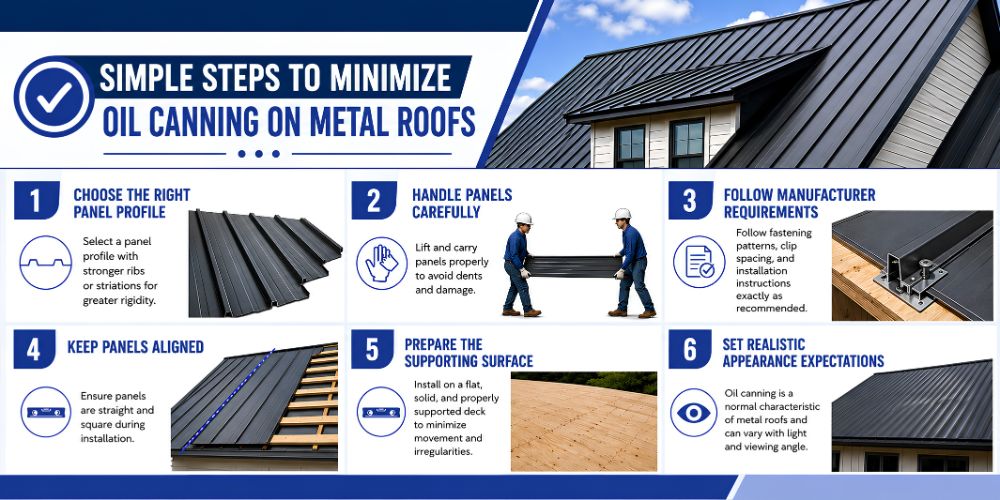
There is no way to guarantee that oil canning will never appear, but good planning and installation can reduce the chance of noticeable distortion.
Choose an Appropriate Panel or Profile
Panel geometry affects how much distortion can be seen, so choosing the right metal roofing system can influence both appearance and performance.
Broad, flat surfaces tend to show waviness more clearly, so panel selection should consider both performance and appearance expectations.
Handle Panels Properly
Metal panels should be handled carefully during delivery, storage, and installation.
Unnecessary bending, dragging, or pressure can place stress on the material before it even reaches the roof.
Follow the Manufacturer’s Installation Requirements
Installation should follow the requirements for the specific roofing product.
Fastener placement, panel alignment, and other details should not be treated as universal because systems can differ.
Keep Panels Properly Aligned
Good alignment helps the panels sit correctly and reduces unnecessary stress during installation.
It also improves the finished appearance of the roof.
Consider the Supporting Surface
A properly prepared supporting surface helps the panel maintain the appearance the system was designed to achieve.
If the surface beneath the panel is uneven, that condition can become visible through the finished metal.
Set Realistic Appearance Expectations
Even a properly installed metal roof can show some degree of oil canning.
That’s an important point to understand before installation. The goal is to reduce unnecessary distortion, not promise a perfectly flat appearance under every lighting condition.
Does Oil Canning Go Away?
Sometimes the appearance can change, but that does not mean permanent distortion has corrected itself.
Oil canning may look different depending on:
- Temperature
- Sunlight
- Viewing angle
- Panel movement
A panel may appear flatter in one lighting condition and more visibly wavy in another.
That can make it seem as though the problem has disappeared, when the panel itself has not actually changed.
So if the distortion is permanent, don’t assume it will simply disappear with time. If the appearance is changing or becoming more pronounced, it is worth evaluating the roof rather than waiting for it to correct itself.
Oil Canning on Standing Seam Metal Roofs
Standing seam metal roof oil canning can be particularly noticeable because standing seam metal roofing uses broad, uninterrupted panels that can make subtle waviness easier to see.
Lighting also plays a major role. Sunlight reflecting across a long uninterrupted panel can highlight shallow waves that might be barely noticeable under overcast conditions.
That does not mean standing seam roofing is inherently defective. It simply means appearance expectations are especially important with large, visually clean panel surfaces.
When Should You Have a Metal Roof Inspected?
If you’re looking at a wavy metal roof and can’t tell whether you’re seeing oil canning or something more serious, an inspection can help separate appearance issues from functional problems.
Pay closer attention when you notice:
- New or rapidly changing distortion
- Visible panel separation
- Loose or damaged fasteners
- Water leaks
- Damaged seams or flashing
- Obvious physical deformation
- Storm or impact damage
From the ground, it’s easy to focus on the waviness and miss what’s happening around it. A closer inspection can reveal whether the panel is simply showing oil canning or whether there are loose fasteners, movement, or other signs of damage.
If the roof is otherwise dry, secure, and performing normally, mild oil canning may not require immediate repair. The key is understanding what you’re actually seeing before deciding what to do about it.
Conclusion
Oil canning can make a metal roof look uneven or wavy, but the appearance alone does not mean the roof is failing. Panel stress, manufacturing, handling, installation, the supporting surface, and panel geometry can all contribute to visible distortion.
In many cases, the issue is primarily cosmetic. When waviness appears alongside leaks, loose panels, damaged fasteners, or significant deformation, though, it deserves a closer look.
The best approach is to understand the difference between normal-looking panel waviness and signs of a genuine roofing problem, then address the underlying cause rather than trying to force the metal flat.
FAQs
Can minor waves in a metal roof be left alone?
Minor waviness can often be monitored when the panels are secure and the roof has no leaks, loose fasteners, damaged seams, or other obvious problems. The appearance alone does not always mean the roof needs repair.
How can you tell if metal roof waves are serious?
Look for changes beyond the surface appearance. Waves that become more pronounced, occur with panel movement, have loose fasteners, leaks, or visible deformation deserve closer inspection.
What makes oil canning more noticeable?
Lighting can make a big difference. Direct sunlight reflecting across broad, relatively flat panels can highlight shallow waves that may be difficult to see under cloudy conditions or from another angle.
Does standing seam metal roofing show more oil canning?
It can be more noticeable on standing seam roofs because the panels often have broad, uninterrupted surfaces. That does not mean standing seam roofing is defective; the smooth panel design can simply make subtle waviness easier to see.
Can oil canning be prevented before installation?
It cannot always be prevented completely, but careful panel handling, proper alignment, following the manufacturer’s installation requirements, and preparing the supporting surface correctly can reduce the chance of noticeable distortion.
When should metal roof waviness be inspected?
Have the roof inspected when the waviness is new, getting worse, or accompanied by leaks, loose panels, damaged fasteners, separated seams, or other visible changes. An inspection can help determine whether you’re seeing an appearance issue or a larger roofing problem.