If fire resistance is high on your list, metal roofing is worth considering. Steel and aluminum are non-combustible materials, so the metal itself does not provide fuel for a fire. Many metal roofing systems can achieve a Class A fire classification when the specific roof assembly has been tested and classified accordingly.
The metal panel is only one part of the equation. The decking, underlayment, other roofing components, and installation configuration can all affect the fire performance of the finished system.
The key is understanding how the metal performs, what a Class A rating actually tells you, and how the complete roof compares with other fire-resistant options.
Are Metal Roofs Fire Resistant?
Yes. Metal roofs are generally highly fire-resistant because materials such as steel and aluminum are non-combustible. They do not readily ignite or provide the same combustible fuel that wood-based roofing materials can.
That makes metal a strong option when fire exposure is a concern. A metal roof can also perform well when exposed to burning embers or radiant heat, depending on the complete roofing assembly and how the roof is detailed.
Fire-resistant doesn’t mean fireproof. A metal roof may resist ignition and certain fire exposures, but no roofing material makes the entire home immune to fire. The roof still includes other materials, and vulnerable areas such as vents, penetrations, edges, and joints can affect the way the system performs.
That is why a fire-resistant metal roof should be evaluated as a complete roofing system rather than simply as a sheet of metal.
What Does a Class A Fire Rating Mean?
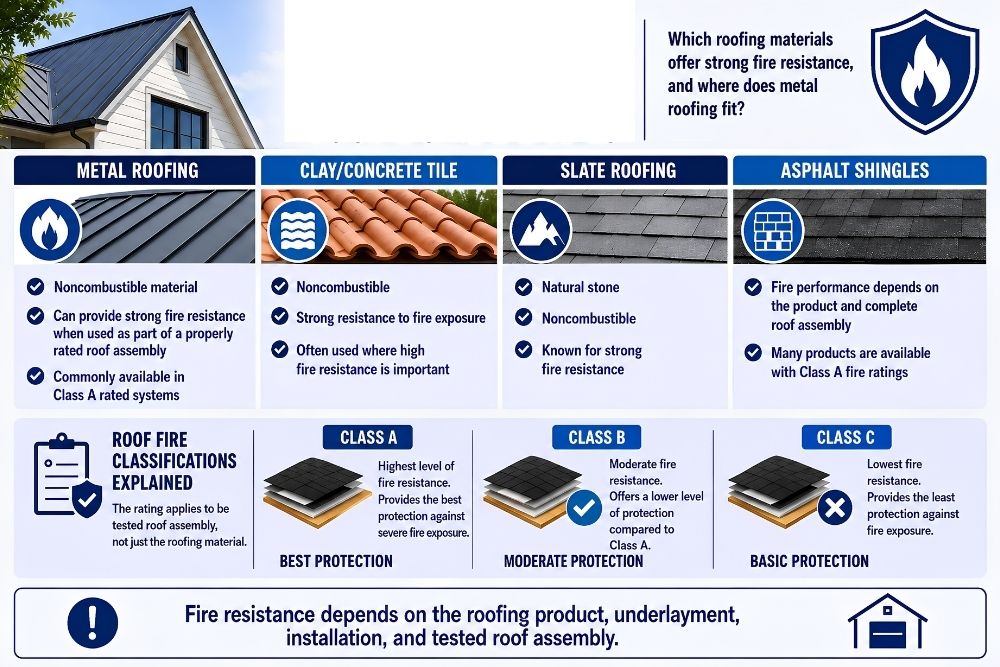
Class A is the highest of the common Class A, B, and C exterior fire-exposure classifications for roof coverings. It tells you how the tested roof covering or assembly performed under specified fire exposures. For homeowners, it is one of the most important ratings to understand when comparing fire-resistant roofing materials.
A roof’s fire classification is based on how the tested assembly performs under specified fire exposure. The rating is not simply assigned because the visible roof covering is made from a particular material.
In practical terms:
- Class A provides the highest level within the common Class A, B, and C roof classifications.
- Class B provides a lower level of fire resistance.
- Class C provides a lower level still.
The exact classification depends on the product and the assembly that was tested.
That means a homeowner should not assume that every metal roof has the same rating. If a Class A metal roof is important to you, ask for the fire classification of the specific roofing system being installed.
Think of it this way: the metal panel is one ingredient. The rating applies to the finished recipe.
How Does a Metal Roof Perform During a Fire?
When a metal roof is exposed to fire, the metal itself is not expected to ignite like a combustible roofing material.
That can be especially useful when the roof is exposed to:
- Burning embers
- Radiant heat
- Direct flame exposure
Wind-blown embers can be a serious concern during a nearby fire because they may land on the roof before flames ever reach the building.
A non-combustible roof covering removes one potential fuel source from that part of the home. But that does not make the entire roof or house fireproof.
Roof edges, vents, penetrations, debris, and materials below the metal can still matter. A gap around a penetration or combustible debris sitting against the roof can create a vulnerable point even when the main roof covering is highly fire-resistant.
So the better question is not simply, “Does metal burn?”
It is:
How does the complete roofing assembly perform when exposed to fire and embers?
Metal Roof vs. Asphalt Shingles for Fire Resistance
Metal and asphalt shingles are often compared as though one is automatically fire resistant and the other is not. The reality is more nuanced.
Many fiberglass asphalt shingle systems can achieve a Class A fire classification, just as many metal roofing assemblies can.
| Feature | Metal Roofing | Asphalt Shingles |
| Combustibility | Metal itself is non-combustible | Depends on product construction |
| Class A Availability | Available with qualifying tested systems | Many fiberglass systems can achieve Class A |
| Ember Exposure | Metal itself is non-combustible; overall performance depends on the tested assembly | Depends on the specific product and assembly |
| Overall Fire Performance | Depends on complete assembly | Depends on complete assembly |
| Material Behavior | Does not provide combustible fuel | Varies by shingle construction |
So if you’re choosing between a Class A metal roofing system and a Class A asphalt shingle system, the Class A label alone does not tell you everything.
The two systems may differ in weight, durability, maintenance, installation requirements, and how their other components are built.
That is a better comparison than simply asking which material is “fireproof.”
What Are the Best Fire-Resistant Roofing Materials?
There is no single roofing material that is automatically the best choice for every property. Several roofing materials can provide strong fire performance when the specific product and complete assembly are properly tested.
Metal Roofing
Steel and aluminum are non-combustible materials, and many metal roofing systems can achieve strong fire classifications. Metal is also attractive to homeowners who want a long-lasting roofing material with good resistance to severe weather.
Asphalt Shingles
Fiberglass asphalt shingles can achieve Class A fire performance in many systems. The exact rating depends on the product and the assembly in which it is installed.
Concrete and Clay Tile
Concrete and clay tile are non-combustible materials and can provide strong fire resistance. Their weight is an important consideration, though, because the structure needs to support the roofing system properly.
Slate Roofing
Slate roofing is naturally non-combustible and has strong fire-resistant characteristics. It is also a heavy material and requires installation methods suited to the roof structure.
Wood Shingles and Shakes
Wood shingles are combustible, so it behaves differently from metal, tile, or slate during fire exposure. Some treated wood products can provide improved fire performance, but the specific product and tested system matter.
The best choice depends on more than the material name. Fire classification, roof design, installation, local conditions, and the rest of the roofing assembly all deserve consideration.
What Makes a Roof Fire Resistant Besides the Roofing Material?
The roof covering is only one part of the system.
A roof can have a highly fire-resistant surface and still contain other components that affect its overall performance.
Important parts include:
- Roof decking
- Underlayment
- Flashing
- Vents
- Roof penetrations
- Roof edges
- Gutters
- Installation details
- Combustible debris around the roof
This is why fire resistance is a roof-system issue, not simply a material-label issue.
For example, a vent opening needs to be properly detailed. Roof edges need to be installed correctly. Debris should not be allowed to collect against the roof or inside gutters.
The metal panel may be non-combustible, but the finished roof still has to function as a complete system.
Can a Metal Roof Protect a Home From Wildfire?
A properly designed and tested metal roofing system can reduce one source of vulnerability during a wildfire because the metal covering itself is non-combustible.
But no roof should be treated as complete wildfire protection for the entire home.
Wind-blown embers can reach:
- Roof edges
- Vents
- Openings
- Penetrations
- Gutters
- Areas where combustible debris has collected
Radiant heat and nearby flames can also affect other parts of the building.
For that reason, wildfire resistance is best viewed as part of a larger fire-protection strategy. The roof matters, but so do the details around and beneath it.
In Texas, fire-resistant roofing is not only a wildfire concern. Dry vegetation, wind-blown debris, and neglected roof edges or gutters can also create avoidable fire hazards.
If Both Metal and Shingles Are Class A, Which Is Better?
A Class A rating tells you how the tested roofing system performed under the applicable fire exposure. It doesn’t mean two Class A roofs are otherwise identical.
Metal and asphalt systems can differ in construction, weight, maintenance, durability, and installation. The roof deck, underlayment, and other components can also affect the overall assembly.
When comparing two Class A systems, look at the complete roof rather than the rating alone. For a homeowner, the better choice depends on the property’s needs, climate, roof design, and how the system will be installed.
How Can Homeowners Improve Roof Fire Resistance?
Fire resistance is easier to maintain when the roof is kept in good condition year-round.
A few practical steps can help:
- Choose a roofing system with a verified fire classification.
- Confirm the rating applies to the actual assembly being installed.
- Keep gutters clear of leaves and combustible debris.
- Inspect roof penetrations and vents.
- Repair damaged roofing components promptly.
- Keep branches and other combustible debris away from the roof.
- Maintain flashing and other vulnerable roof details.
These are simple maintenance steps, but they can help reduce avoidable vulnerabilities.
Conclusion
Yes. Metal roofing is generally highly fire-resistant because materials such as steel and aluminum are non-combustible. Many metal roofing systems can also achieve Class A fire performance when the complete assembly is tested and rated accordingly.
The important distinction is that not every metal roof automatically has the same fire rating, and no roofing material makes an entire home completely fireproof.
If fire resistance is high on your list, don’t stop at the word “metal.” Ask about the fire classification of the complete roofing system.
FAQs
What is the best fire-resistant roof?
There is no single roofing material that is always best for every property. Metal, clay tile, concrete tile, slate, and many fiberglass asphalt shingle systems can provide strong fire resistance. The specific product and tested roof assembly matter.
Are metal roofs fireproof?
No. Metal itself is non-combustible and highly fire-resistant, but it is more accurate to describe a metal roofing system as fire-resistant rather than completely fireproof. Other parts of the roof and the building can still be damaged by severe fire exposure.
Are asphalt shingles fire-resistant?
Many fiberglass asphalt shingle systems can achieve a Class A fire classification. However, not every shingle product has the same fire performance, so homeowners should check the specific product and roofing assembly.
What is the biggest fire risk to a roof?
Burning embers, combustible debris, vulnerable openings, and damaged roofing components can all create fire vulnerabilities. A highly fire-resistant roof still benefits from proper maintenance and attention to vents, edges, gutters, and penetrations.
Can a Class A metal roof still be damaged by fire?
Yes. Class A means the tested roofing assembly demonstrated strong resistance under the applicable exterior fire exposure. It does not mean the roof or home is immune to damage from severe fire, radiant heat, or prolonged exposure.